While there have been a few scorching days this summer, on the whole, this summer has definitely been milder. While the ground in many parts of my garden is still dry, the growth seems lusher and this is also reflected in surrounding paddocks which are still green, whereas they would usually have been brown and dry for months.
To me, the test of a good garden is one which has plants providing colour and interest all year round, not meaning that the one plant does it all, but there is a succession of seasonal interest. As an added bonus I also love to have scented plants in my garden all year round. So here are some of my favourite summer stunners which are in bloom at the moment.
Trees
Jacaranda
After 11 years, my large jacaranda on the front lawn has finally flowered this summer and it is breath taking. We are marginal to grow jacarandas due to our frosts down to minus 5, even though there are some in the town of Mt Barker (where they grow adjacent to bitumen which affords them a heat bank and special microclimate) and also the nearby town of Wistow (however theirs is slightly more elevated than my front lawn so unlikely to get frosted). It was actually one of three planted in early 2012 and my vision was to have Luscious, our house dragon lying in a carpet of purple flowers. At last that vision has become a reality. The one that is in flower is closest to the paving and grew, presumably because the paving acts as a heat bank in winter and elevates the air temperature slightly, although the second one while surviving, is still just marginally bigger than it was when we planted it. The third one which was furthest from the paving never survived, and neither did the other 7 or 8 I planted in the years since. Through this I have learned that the younger and fresher green the stem, the more sensitive the trunks are to the cold, so if you are in a marginal area, get a larger tree and preferably one which already has a woody trunk. One year, I even went to the trouble of wrapping the trees in frost cloth and straw, held together knitted scarves, to try and protect them from the frost. Even then, my two remaining jacarandas do get die back each winter, which I cut out as they start to grow in late spring.
Crepe Myrtles (Lagerstroemia cultivars)
These really are amazing small to medium sized trees, and I do find myself raving about them each year, but they reward me with flowers for 60-100 days each summer and their flowers thrive in extreme heat, so why wouldn’t I rave? They come in a range of colours from white to shades of pink lavender and pinkish red, however the ones I seem to have most are the pure white ‘Natchez’. They can be seen all over Adelaide and the Hills, and they are street trees in some areas of Adelaide, including in the western suburbs where the radiant heat from the bitumen and pavement would be extreme. Most have glossy green foliage which is small and rounded and in autumn it turns vibrant shades of gold, orange and red in autumn, although some new cultivars have dark burgundy foliage. In winter, once their leaves have fallen and their branches are bare, their exfoliating bark becomes a striking feature in mottled shades of grey, cinnamon and tan. Around Mt Barker (along Cameron and Alexandrina Roads) and Strathalbyn (outside the library) you can also see some stunning specimens of ‘Tuscarora’, a reddish pink variety with an upright, vase-shaped tree habit.
Persian silk tree (Albizia julibrissin)
These deciduous small trees have delicate looking, ferny foliage and dainty silk-like flowers which appear in mid-summer. The blooms have a soft sweet scent, but it is only really noticeable when you stick your nose into them. I planted a pair either side of a seat above my vegie garden and they are a delight to behold. Even when the individual blooms pass their best, more keep opening and they flower for a couple of months – maybe not as long as a crepe myrtle, but certainly more than many trees grown for their spring bling which can last only a few weeks.
Shrubs and perennials

Butterfly Bushes (Buddleja species)
These shrubs are a must on many levels, and I am often raving about them as they can flower from spring to autumn. They are beloved by butterflies, bees and honey eating birds, but their scent is a delight for us humans too. They produce cone shaped heads of flowers which have a rich sweet scent with flower colours ranging from pure white and lemon-yellow, to pink and many shades of lavender and purple. There are lots of different varieties ranging from dwarf forms which still get 1.2-1.5m high to tall shrubs of 3-4m high. They are sun lovers and repeat flower for a very long time if you can dead head them.

Violet tubeflowers (Iochroma cyaneum and cultivars)
These fast growing, upright shrubs cover themselves in pendant clusters of violet or purple tubular flowers in a massed display for a long period in summer and autumn. I have several different forms, including one with plum and one with salmon-coloured flowers. These plants are frost tender, but I get away with growing them if they are hard up against the stone walls of my home, although they do become fully deciduous whereas in town in frost free positions they are evergreen and can grow 3-5 metres high. Honey eating birds love their tubular flowers.
Paraguayan Nightshade (Solanum rantonnetii)
This sun-loving plant forms a large arching bush 2 to 3metres high and flowers prolifically with flat purple flowers with golden centres smothering it for a long period during spring, summer, and autumn. It does not like the frost in the Adelaide Hills, so this is another plant I grow against the stone walls and even though it does become deciduous, it bounces back each year in spring. Bees love these flowers and I regularly spot native blue banded bees bussing around the flowers.
Plumbago ‘Royal Cape’
This deeper blue flowered form of the old fashioned plumbago flowers over a very long period from spring to autumn, and unlike its more rampant old-fashioned ancestor, ‘Royal Cape’ also holds its intense blue flower colour and does not fade however hot the weather gets. The only requirement of this tough, reliable plant is a frost-free position and be sure to prune it regularly after flowering. I am only able to grow this plant against the stone walls of my home, however in a frost-free area it grows even better and flowers for a longer period, from spring to autumn.
Duranta ‘Geisha Girl’
To be honest, this is not something I can grow in my garden, due to my harsh frosts but if I had a frost-free garden I would definitely grow it. This tall shrub is extremely hardy and quick growing and makes a great hedge or screen. It produces sprays of white rimmed, deep purple, wavy edged flowers near the tips of arching branches for many months from spring to autumn. These flowers are also beloved by the native blue banded bee which is a bonus for our tomatoes, chillies and capsicums grow bigger and taste better.
Salvias
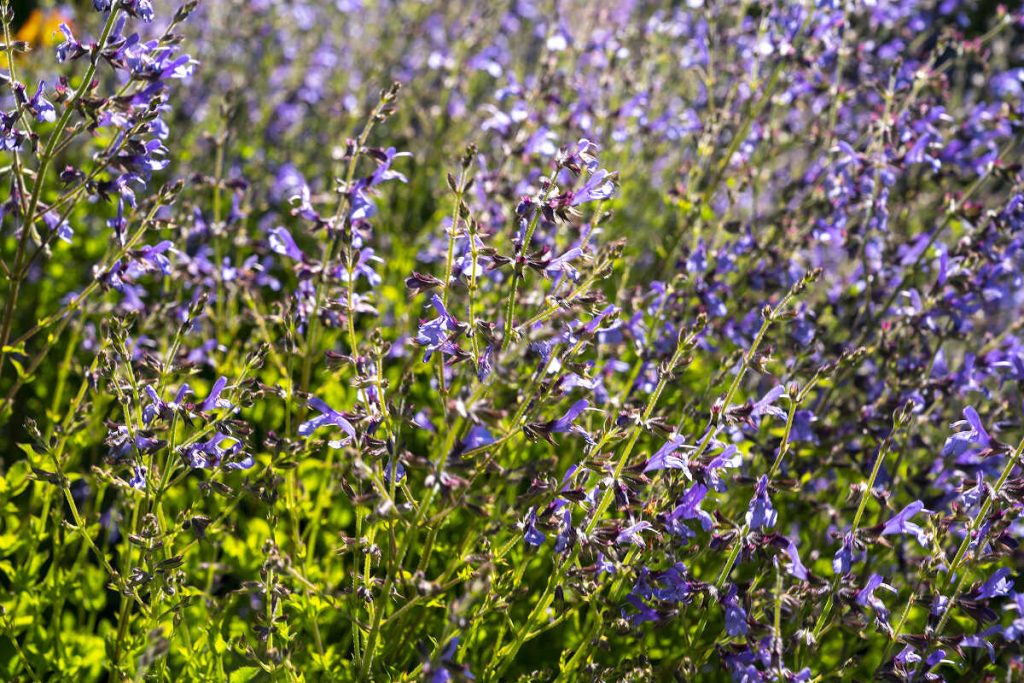
There are so many different salvias and at the moment there are five varieties in full bloom in my garden. The Canary Island sage (Salvia canariensis var. candidissima) which continues to look stunning.
Salvia muirii virtually flowers all year round, but somehow it is in summer when it’s clear blue flowers really shine. Not only do I love its flowers but so do the bees. This plant has small foliage and small flowers and just needs a light prune to keep it tidy at around 1 metre high by a similar width.
Salvia ‘African Skies’ is another bee magnet which produces a mass of clear blue flowers for many months in the warmer weather, and unlike many of the other dry tolerant varieties, has lush looking mid green foliage to 1m by 1.5m wide.
Bog Sage (Salvia uliginosa) is a clump forming perennial to 1.2m high which smothers itself in vivid blue flowers on slender stems which sway beautifully in the breeze and are beloved by bees and butterflies. The downside of this sage however is that it has a tendency to run and misbehave, yet in my predominantly hot dry garden, it is only spreading in the moist ‘bog-like’ area of the septic and spreading only to the limit of the moisture. This sage benefits from being cut to ground level at the end of its flowering period in autumn.
Verbena
These perennials range from groundcovers and low perennials to tall plants my height. They are loved by bees and butterflies, with my favourite being Verbena bonariensis. This tall flowering perennial produces upright stems to more than 1.5m high topped with purple flowers creating a stunning lacy and it is a favourite of blue banded bees in my garden. The reason you want these native bees in your garden is that they are buzz pollinators and make your tomatoes taste better.

Shasta Daisies
These spreading perennials are beloved for their clean white daisy flowers with golden yellow centres which appears in late spring and early summer. There are single and double flowered forms, and both make great cut flowers. The flowers arise from a basal clump of foliage and like other summer-flowering perennials, they benefit from dead heading throughout their growing season, and they need to be pruned back hard at the end of autumn to encourage vigorous new growth. They do prefer to be kept moist and they look daggy and can burn if they are not.

Be sure to include some of these hardy and reliable summer stunners in your garden.